Past Events
Vibe Coding Miami
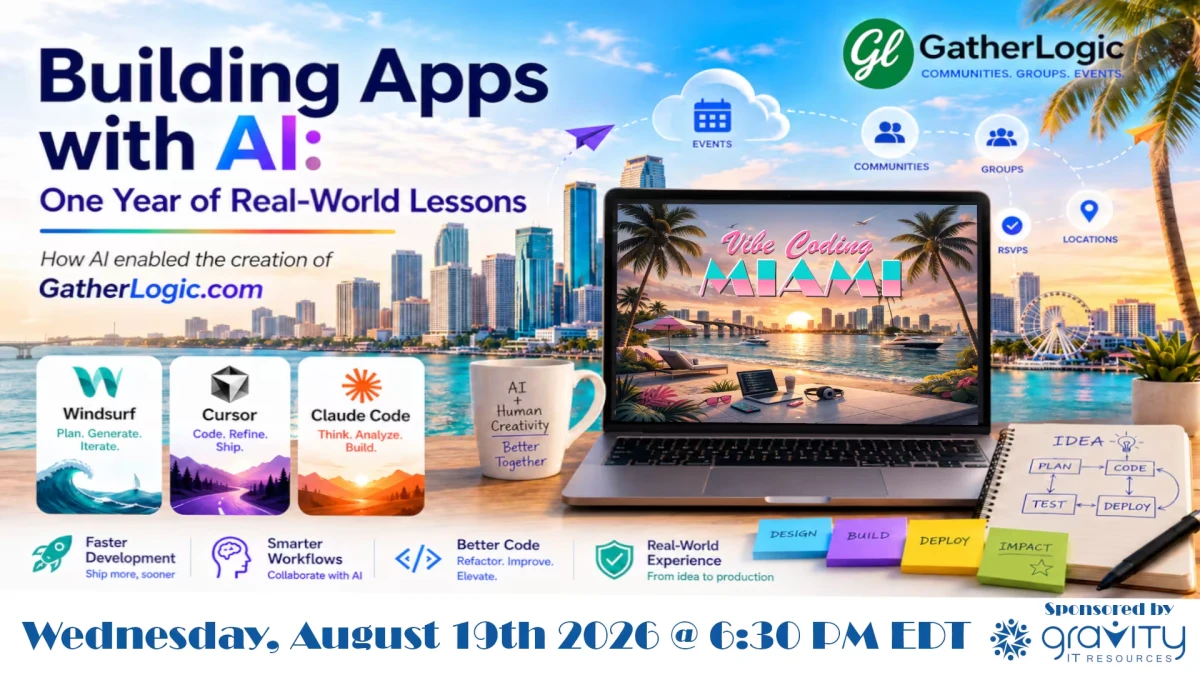
Building Apps with AI: One Year of Real-World Lessons ❌ Canceled
🗓️ Wednesday, August 19, 2026, 6:30 PM to 8:30 PM EDT
📍 Gravity IT Resources · Fort Lauderdale, FL 33308 · United States
Building Apps with AI: One Year of Real-World Lessons
How AI enabled the creation of GatherLogic.com
AI has evolved from an interesting coding assistant into an essential software development tool. But what is it really like to build a production application with AI every day?
This session shares one year of practical lessons learned using ChatGPT, Windsurf, Cursor, and Claude Code to design, develop, and launch GatherLogic.com, a SaaS platform for managing communities, groups, and events. Rather than showcasing AI-generated demos or isolated code examples, we'll examine how AI performs throughout the software development lifecycle and what actually works in production.
We'll explore where AI dramatically accelerates development, where it still falls short, and how to collaborate effectively with AI on software architecture, debugging, refactoring, API integration, testing, and documentation. Along the way, we'll compare the strengths of today's leading AI development tools and discuss when each is most effective.
The techniques presented are intentionally programming-language agnostic. Whether you develop in Java, C#, Python, JavaScript, Go, Rust, PHP, or another language, you'll see software engineering practices and AI collaboration patterns that apply across languages and technology stacks.
You'll leave with practical techniques, realistic expectations, and reusable development patterns that will help you integrate AI more effectively into your own software projects. Most importantly, you'll discover that successful AI-assisted development still depends on sound engineering judgment—and learning to collaborate effectively with AI can help you build better software, faster.
Schedule:
6:30PM-7:00PM EST Networking /w food and refreshments
7:00PM-8:00PM EST Presentation
8:00PM-8:30PM EST Q&A Discussion
Parking:
Free parking is available in the garage (excluding the reserved parking spots, painted yellow for distinction) and in the outside parking lot directly in front of the building's entrance.
Gravity IT Resources is graciously hosting this event in their Fort Lauderdale office. Thank you, Gravity, for your support.
This a joint presentation with the Miami Java User Group
Miami Java User Group
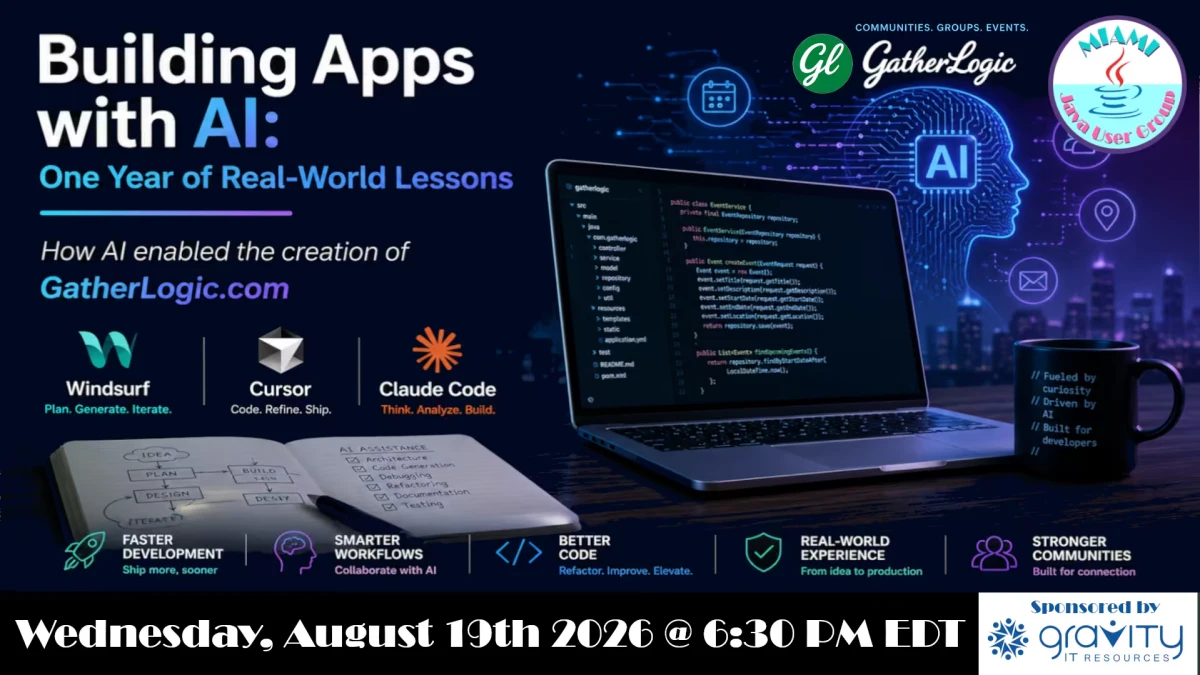
Building Apps with AI: One Year of Real-World Lessons ❌ Canceled
🗓️ Wednesday, August 19, 2026, 6:30 PM to 8:30 PM EDT
📍 Gravity IT Resources · Fort Lauderdale, FL 33308 · United States
Building Apps with AI: One Year of Real-World Lessons
How AI enabled the creation of GatherLogic.com
AI has evolved from an interesting coding assistant into an essential software development tool. But what is it really like to build a production application with AI every day?
This session shares one year of practical lessons learned using ChatGPT, Windsurf, Cursor, and Claude Code to design, develop, and launch GatherLogic.com, a SaaS platform for managing communities, groups, and events. Rather than showcasing AI-generated demos or isolated code examples, we'll examine how AI performs throughout the software development lifecycle and what actually works in production.
We'll explore where AI dramatically accelerates development, where it still falls short, and how to collaborate effectively with AI on software architecture, debugging, refactoring, API integration, testing, and documentation. Along the way, we'll compare the strengths of today's leading AI development tools and discuss when each is most effective.
The techniques presented are intentionally programming-language agnostic. Whether you develop in Java, C#, Python, JavaScript, Go, Rust, PHP, or another language, you'll see software engineering practices and AI collaboration patterns that apply across languages and technology stacks.
You'll leave with practical techniques, realistic expectations, and reusable development patterns that will help you integrate AI more effectively into your own software projects. Most importantly, you'll discover that successful AI-assisted development still depends on sound engineering judgment—and learning to collaborate effectively with AI can help you build better software, faster.
Schedule:
6:30PM-7:00PM EST Networking /w food and refreshments
7:00PM-8:00PM EST Presentation
8:00PM-8:30PM EST Q&A Discussion
Parking:
Free parking is available in the garage (excluding the reserved parking spots, painted yellow for distinction) and in the outside parking lot directly in front of the building's entrance.
Gravity IT Resources is graciously hosting this event in their Fort Lauderdale office. Thank you, Gravity, for your support.
This a joint presentation with Vibe Coding Miami
Miami Java User Group
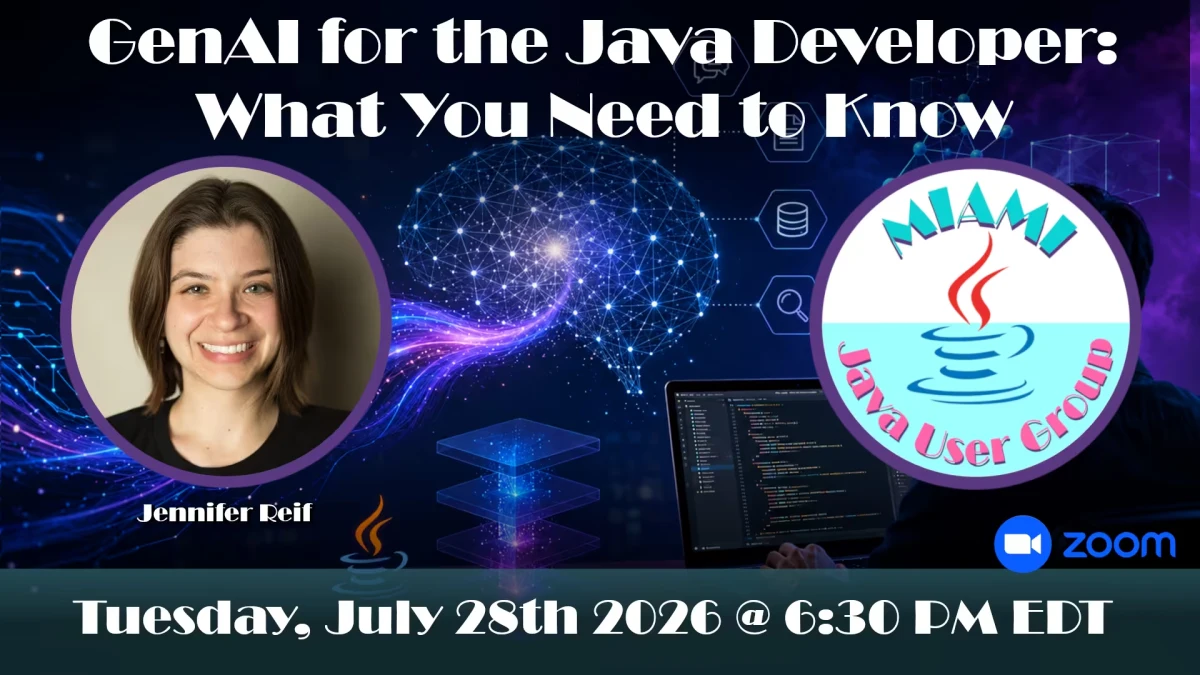
GenAI for the Java Developer: What You Need to Know
🗓️ Tuesday, July 28, 2026, 10:30 PM UTC - Wednesday, July 29, 2026, 12:30 AM UTC
💻 Online Event
You’ve been tasked with implementing or learning AI, whether that includes LLMs, RAG, or MLOps. The sea of acronyms in this era of AI can feel like (and sometimes actually are) a black box for the complex logic and processes that underpin them. There’s so much to learn and not enough time.
In this session, we’ll explore how these technologies operate and the different practical ways GenAI is being used. We will explain common architectures for applications with GenAI, including RAG and GraphRAG. Live-code examples will show how Java developers can start using GenAI and help determine where they can be best applied. Come see how to play in the GenAI era.
Schedule:
6:30PM-7:00PM EST Networking
7:00PM-8:30PM EST Jennifer's presentation with Q&A
Miami Java User Group

Unleashing Vector Search with Spring AI, LangChain4J, and Hibernate Vector
🗓️ Tuesday, April 7, 2026, 6:30 PM to 8:30 PM EDT
📍 Carl DeSantis Building · Davie, FL 33314 · United States
This session explores building AI-related solutions with Java, leveraging popular open-source frameworks such as Hibernate Vector, Spring AI, and LangChain4J. We’ll explore design patterns such as RAG, agentic AI, and vector search for storing, querying, and retrieving vector embeddings.
Attendees will learn how to implement vector search for a range of AI-driven applications, with practical examples backed by Oracle Database and code samples that can be easily modified to use any vector database, as the concrete implementations are interface (contract)- oriented.
Schedule:
6:30PM-7:00PM EST Networking
7:00PM EST Presentation with Q&A
Parking:
NSU Library and Main Student parking is located across from the DeSantis building. Hourly parking fees can be paid via the PayByPhone app or at the pay booths. NSU Parking Map
Thanks to NSUFlorida for providing the venue for the event.
This event is also listed on Meetup.
Miami Java User Group

Meet Kiro: The AI IDE for prototype to production
🗓️ Thursday, March 26, 2026, 6:30 PM to 8:30 PM EDT
📍 DOCK by The LAB Miami · Miami, FL 33127 · United States
Join us for an exclusive in-person session where we'll explore Kiro: an AI-powered developer platform designed to help you turn ideas and specs into real, working code in minutes.
Kiro doesn't just autocomplete your code, it understands your project specs, context, and intent and then helps you design, generate, and refine your applications intelligently.
You'll see a live walkthrough and demo showing how Kiro's AI agents helps you scale and uplevel your work while keeping you in the driver's seat.
Why attend?
- Discover how Kiro integrates with your favorite languages and frameworks
- Learn how AI agents can support your entire dev workflow from specs to deployment
- Get inspired to embrace AI-Driven Development Lifecycle (AI-DLC)
- Network with other AWS and AI enthusiasts in the Miami tech community
Languages supported: JavaScript, TypeScript, Python, and Java.
Schedule:
6:30PM-7:00PM EST Networking
7:00PM EST Presentation with Q&A
Thanks to the LAB Miami for providing the event space.
👉 Metered parking is on a first-come, first-served basis, you must pay via app (like PayByPhone). The safest option is the Wynwood Garage at 311 NW 26th St, just a short 2-minute walk from The Dock.
This is a joint presentation with the Miami AWS User Group and Vibe Coding Miami.
Vibe Coding Miami

Meet Kiro: The AI IDE for prototype to production
🗓️ Thursday, March 26, 2026, 6:30 PM to 8:30 PM EDT
📍 DOCK by The LAB Miami · Miami, FL 33127 · United States
Join us for an exclusive in-person session where we'll explore Kiro: an AI-powered developer platform designed to help you turn ideas and specs into real, working code in minutes.
Kiro doesn't just autocomplete your code, it understands your project specs, context, and intent and then helps you design, generate, and refine your applications intelligently.
You'll see a live walkthrough and demo showing how Kiro's AI agents helps you scale and uplevel your work while keeping you in the driver's seat.
Why attend?
- Discover how Kiro integrates with your favorite languages and frameworks
- Learn how AI agents can support your entire dev workflow from specs to deployment
- Get inspired to embrace AI-Driven Development Lifecycle (AI-DLC)
- Network with other AWS and AI enthusiasts in the Miami tech community
Languages supported: JavaScript, TypeScript, Python, and Java.
Schedule:
6:30PM-7:00PM EST Networking
7:00PM EST Presentation with Q&A
Thanks to the LAB Miami for providing the event space.
👉 Metered parking is on a first-come, first-served basis; you must pay via app (like PayByPhone). The safest option is the Wynwood Garage at 311 NW 26th St, just a short 2-minute walk from The Dock.
This is a joint presentation with the Miami AWS User Group and Miami Java User Group.
Miami Java User Group

We hate code - The !joy of maintaining dead code ❌ Canceled
🗓️ Thursday, February 26, 2026, 6:30 PM to 8:30 PM EST
📍 Gravity IT Resources · Fort Lauderdale, FL 33308 · United States
Do you love to maintain code that you didn’t write? Probably not…
As systems grow and evolve, the codebase inevitably accumulates clutter, including unused or “dead” code. Often, the developers who wrote that code are not even in the company anymore. So how do you know if the code is still used? Dead code can be confusing and it can be the source of vulnerabilities in your code base. So it is not only “legacy” code we have to deal with, but also “dead” code and even so-called “zombie” code.
This session will give you an overview of the common struggles with these types of code and it will try to give you an idea about the differences between those types of code and about tools like JaCoCo or OpenRewrite in combination with Intelligence Cloud, that will help you to get rid of it.
Speaker:
Gerrit Grunwald is a software engineer that loves coding for around 40 years already. He is a true believer in open source and he is an active member of the Java community, where he founded and leads the Java User Group Münster (Germany), he is a JavaOne rockstar and a Java Champion. He speaks at conferences and user groups internationally and writes for several magazines.
Parking:
Free parking is available in the garage (excluding the reserved parking spots, painted yellow for distinction) and in the outside parking lot directly in front of the building's entrance.
Schedule:
6:30PM-7:00PM EST Networking
7:00PM EST Presentation with Q&A
Gravity IT Resources is graciously hosting this event in their Fort Lauderdale office. There is free parking at this event. Thank you, Gravity, for your support.
Miami Java User Group

Deploying to production with confidence
🗓️ Tuesday, January 27, 2026, 4:30 PM to 6:00 PM UTC
💻 Online Event
How many times have we asked ourselves if it is a good idea to release to production on a Friday afternoon? Is the production software sufficiently robust and/or resilient to vulnerabilities? How can we detect and correct security problems in production? Better yet, how can we prevent such problems or attacks?
In recent years the topic Software Supply Chain Security has taken on greater importance. Concepts like SBOMs, SLSA, Reproducible Builds, CI/CD Security are widely discussed to answer the previously posited questions. In this session we will discover what are these concepts and how you may apply them to your own projects.
Speaker:
Andres Almiray is a Java/Groovy developer and a Java Champion, Developer Advocate, with more than 2 decades of experience in software design and development. He has been involved in web and desktop application development since the early days of Java. Andres is a true believer in open source and has participated on popular projects like Groovy, Griffon, and DbUnit, as well as starting his own projects. Founding member of the Griffon framework and Hackergarten community event. Author of JReleaser. You can find him on X as @aalmiray.
Schedule:
11:30AM-12:00PM EST Networking
12:00PM-1:00PM EST Andres presentation with Q&A
Rust Miami

Building Web Applications with Actix Web
🗓️ Wednesday, December 10, 2025, 11:30 PM UTC - Thursday, December 11, 2025, 1:30 AM UTC
💻 Online Event
Join us for a hands-on introduction to Actix Web, one of Rust's most popular and performant web frameworks. Whether you're new to web development in Rust or exploring alternatives to other frameworks, this talk will get you up and running with Actix Web.
We'll begin with a brief overview of Actix Web's architecture and ecosystem, and discuss why it stands out among Rust web frameworks. Then, we'll dive into building a real application together, covering essential concepts like routing, handlers, extractors, and error handling.
By the end of this session, you'll have a solid foundation for building your own web services with Actix Web and understand the trade-offs that make it an excellent choice for many Rust projects.
What to expect:
- Introduction to Actix Web and the Rust web framework landscape
- Live coding walkthrough of an example application
- Practical tips for getting started with your own projects
Prerequisites: Basic familiarity with Rust. Bring a laptop if you'd like to code along!
Speaker:
Nathan Reller
Nathan is the founder of Ginger Cybersecurity. Ginger Cybersecurity is a tech startup focused on easily enabling all businesses to defend themselves from and respond to cyberattacks in the cloud. Nathan is responsible for the development of their endpoint detection system.
Prior to founding Ginger Cybersecurity, Nathan worked as a cybersecurity researcher at the Johns Hopkins University Applied Physics Laboratory (JHU/APL). Nathan pursued research in the areas of cloud security, trusted computing, measurement and attestation, and Security Orchestration, Automation and Response (SOAR). He has been recognized for his innovative thinking. He was a member of the team that won the 2012 Invention of the Year award and led a team that won a 2022 Propulsion Grant. He also has two patents related to cybersecurity.
In his free time, Nathan enjoys spending time outdoors with his family.
Schedule:
6:30 PM EST Networking
7:00 PM EST Presentation
Zoom link will be visible after RSVP.
Miami Java User Group

Meet Kiro: The AI IDE for prototype to production
🗓️ Wednesday, November 19, 2025, 6:30 PM to 8:30 PM EST
📍 Gravity IT Resources · Fort Lauderdale, FL 33308 · United States
Join us for an exclusive in-person session where we'll explore Kiro: an AI-powered developer platform designed to help you turn ideas and specs into real, working code in minutes.
Kiro doesn't just autocomplete your code, it understands your project specs, context, and intent and then helps you design, generate, and refine your applications intelligently.
You'll see a live walkthrough and demo showing how Kiro's AI agents helps you scale and uplevel your work while keeping you in the driver's seat.
Why attend?
- Discover how Kiro integrates with your favorite languages and frameworks
- Learn how AI agents can support your entire dev workflow from specs to deployment
- Get inspired to embrace AI-Driven Development Lifecycle (AI-DLC)
- Network with other AWS and AI enthusiasts in the Miami tech community
Languages supported: JavaScript, TypeScript, Python, and Java.
Speakers
Fernando Pena
Head of Cloud, Cloud Solutions Architect, and AWS Community Builder. With over 20 years of experience in technology, he's passionate about helping developers and businesses innovate using cloud and AI.
Jimmy Martinez
Sr. Enterprise Solutions Architect @ AWS
A seasoned IT Professional working with Cloud technologies for 11+ years. He has been with AWS for over 5 years and during this tenure has joined both Serverless and Analytics technical field communities as an Enterprise Solutions Architect. Jimmy is 6X AWS Certified and has been a developer advocate through the Miami AWS User Group since January 2023.
Parking:
Free parking is available in the garage (minus the reserved parking spots inside, painted yellow for distinction) and the outside parking lot directly in front of the building's entrance.
Schedule:
6:30PM-7:00PM EST Networking
7:00PM EST Presentation with Q&A
Miami Java User Group

Architecture Patterns for AI-Powered Applications
🗓️ Tuesday, October 14, 2025, 6:30 PM to 8:30 PM EDT
📍 The LAB Miami · Miami, FL 33127 · United States
Since ChatGPT rocketed the potential of generative AI into the collective consciousness there has been a race to add AI to everything. Every product owner has been salivating at the possibility of new AI-Powered features. Every marketing department is chomping at the bit to add a “powered by AI” sticker to the website. For the average layperson playing with ChatGPT's conversational interface, it seems easy however integrating these tools securely, reliably, and in a costeffective manner requires much more than simply adding a chat interface. Moreover, getting consistent results from a chat interface is more than an art than a science. Ultimately, the chat interface is a nice gimmick to show off capabilities, but serious integration of these tools into most applications requires a more thoughtful approach.
This is not another “AI is Magic” cheerleading session, nor an overly critical analysis of the field. Instead, this session looks at a number of valid usecases for the tools and introduces architecture patterns for implementing these usecases. Throughout we will explore the tradeoffs of the patterns as well as the application of AI in each scenario. We'll explore usecases from simple, direct integrations to the more complex involving RAG and agentic systems.
Although this is an emerging field, the content is not theoretical. These are patterns that are being used in production both in Michael's practice as a handson software architect and beyond.
Architects must maintain their breadth, and this session will build on that to prepare you for the inevitable AI-powered projects in your future.
Speaker
Michael Carducci
Michael Carducci is a seasoned IT professional with over 25 years of experience, an author, and an internationally recognized speaker, blending expertise in software architecture with the artistry of magic and mentalism. His book, Mastering Software Architecture, showcases his deep understanding of the multifaceted challenges of building resilient, effective software systems and high-performing teams. Michael's career spans roles from individual contributor to CTO, with a particular focus on strategic enterprise architecture and digital transformation.
As a magician and mentalist, Michael has captivated audiences in dozens of countries, applying the same creativity and problem-solving skills that defined his technology career. He excels in transforming complex technical concepts into engaging narratives, making him a sought-after speaker, trainer, and emcee for internal and tech events worldwide.
In his consulting work, Michael adopts a holistic approach to software architecture, ensuring alignment with business strategy and operational realities. He empowers teams, bridges tactical and strategic objectives, and guides organizations through transformative changes, always aiming to create sustainable, adaptable solutions.
Michael's unique blend of technical acumen and performative talent makes him an unparalleled force in both the tech and entertainment industries, driven by a passion for continuous learning and a commitment to excellence.
Schedule:
6:30PM-7:00PM EST Networking
7:00PM EST Presentation
Location:
The LAB Miami
2750 NW 3rd Ave Suite 24
Miami, FL 33127
👉 Parking Instructions (Discount Available):
The closest option is the Wynwood Garage at 311 NW 26th St, just a short 2-minute walk from The LAB. Guests can access a $10 flat daily rate by following these steps:
- At the garage entrance, select “Other Access Options” (do not select “Get a Ticket”).
- Select “I have an access code.”
- Enter code 0321
⚠️ Please note:
- The code must be entered exactly as instructed; otherwise, the regular full rate will be charged.
Street parking is also available in Wynwood, but the garage is the most reliable and affordable option.
Miami Java User Group

Finding and Crushing Bugs and More with JFR
🗓️ Tuesday, September 9, 2025, 6:30 PM to 8:30 PM EDT
📍 Carl DeSantis Building · Davie, FL 33314 · United States
Some of the most challenging issues a developer will face are slow developing resource leaks, or errors that occur at infrequent intervals. When these issues arise, finding the root cause can be challenging, and developers often resort to adding numerous logging statements around suspected problem areas. What if I told you there was a better option, and that option already existed right in the JVM you are already running? JDK Flight Recorder, as its namesake suggests, is a low-overhead profiling and diagnostic tool that has been built directly into the JDK since JDK 7. In this presentation, we will explore how developers can utilize JFR's powerful API and reporting tools to track down difficult bugs and incorporate JFR into the development process.
Speaker:Billy KorandoBilly is a Java Developer Advocate with the Java Platform Group at Oracle. With over a decade of experience in Java, Billy brings a passion for helping developers reduce tedious work, such as project initiation, deployment, testing, and validation, through automation and by adopting the latest features and tools in the Java ecosystem. Outside of work, Billy enjoys traveling, playing kickball, and cheering on the Kansas City Chiefs. Billy also co-organizes the Kansas City Java users group.
Schedule:6:30PM-7:00PM EST Networking7:00PM EST Presentation with Q&A
Parking:Hourly parking fees can be paid by using the PayByPhone application or pay by booth (only some lots have this option).
Miami Java User Group

Go For the Java Developer
🗓️ Tuesday, July 15, 2025, 10:30 PM UTC - Wednesday, July 16, 2025, 12:30 AM UTC
💻 Online Event
As a Java developer, you may have heard of or even be curious about the Go programming language. This presentation bridges familiar Go and Java concepts, highlighting where Go simplifies common programming tasks while maintaining performance. We'll explore Go's syntax, type system, concurrency model, and error handling through practical comparisons with Java equivalents. We will also explore how Go is utilized in the industry, including in enterprise and cloud-native applications.
Speaker
Vladimir Vivien
Vladimir has been involved and working in the tech industry, crafting code in one form or another, for the past 20 years. I am a passionate engineer who finds joy in building useful and well-architected solutions that deliver values to users.
Schedule:
6:30PM-7:00PM EST Networking
7:00PM EST Presentation with Q&A
Miami Java User Group

Taming Vulnerabilities & Tech Debt with OpenRewrite
🗓️ Tuesday, June 17, 2025, 10:30 PM UTC - Wednesday, June 18, 2025, 12:30 AM UTC
💻 Online Event
Hear how a small team uses OpenRewrite, an innovative, deterministic, open-source automated refactoring ecosystem, combined with generative AI tools to 4X the productivity of security vulnerability remediation and code refactoring at a giant corporation. Learn what worked, how their approach evolved, and what issues they still need to solve.
Speaker
Kevin Brockhoff
Director, Consulting Expert @ CGI
CGI Inc. is a leading multinational global IT and business consulting services firm, headquartered in Canada. It employs approximately 90,000 professionals across 40 countries, offering an end-to-end portfolio of services including business and strategic IT consulting, systems integration, managed IT services, and business process services. Serving a diverse range of industries, including government, banking, health, and manufacturing, CGI helps clients with digital transformation, cloud computing, and cybersecurity. For the fiscal year ending September 30, 2024, CGI reported annual revenue of C$14.68 billion.
Schedule:
6:30PM-7:00PM EST Networking
7:00PM EST Presentation with Q&A
Miami Java User Group

Building Reliable Applications with Temporal
🗓️ Tuesday, June 10, 2025, 6:30 PM to 8:30 PM EDT
📍 Carl DeSantis Building · Davie, FL 33314 · United States
Building modern, reliable applications requires a complex architecture consisting of microservices, queues, databases, and more. The challenge is that everything fails. It’s just a matter of time. Unstable networks, unreliable APIs, and overloaded queues require developers to write extensive additional code to handle all the failure conditions.
Once the application and all of its components are running in production, observing its behavior through the myriad of systems is an exercise in frustration.
What if you could guarantee that any series of services would never fail? What if there is a better way to create, test, and debug reliable applications?
Temporal is an open-source programming model that simplifies your code, makes your applications more reliable, and helps you deliver more features faster. It abstracts away the complexities of retries, rollbacks, queues, state machines, and timers, so that developers can spend their time focused on writing business logic instead of managing all the failure conditions.
Temporal introduces a new paradigm that helps you manage simple tasks or a series of complex procedures, ensuring they are executed reliably until completion, or they will fail elegantly. Developers use their preferred language and development tools, incorporating the Temporal SDK to build reliable applications. Testing becomes as easy as writing and running unit tests.
Agenda
The Challenge with Distributed Systems
Introducing Durable Execution
Introducing Temporal
Architectural View
Demo (depends on how much time we have)
Conclusion
Q&A
Additional Resources
Speaker
Tihomir Surdilovic
Tihomir is a valued member of the Temporal developer success engineering team. As a passionate workflow tech enthusiast, he has been supporting the Temporal community and customers for over three years. In his spare time, he loves fishing and spending time with his family.
Schedule:
6:30PM-7:00PM EST Networking
7:00PM EST Presentation with Q&A
Parking:
Hourly parking fees can be paid by using the PayByPhone application or pay by booth (only some lots have this option).
Miami Java User Group

How Scala Ruined My Java (in a good way)
🗓️ Tuesday, April 22, 2025, 6:30 PM to 8:30 PM EDT
📍 Moderne · Miami, FL 33131 · United States
Scala is a 20 years old language that targets the JVM, Native and JS/WASM. It is concise, type safe and more... Born as a proof of concept for new Java features, initially rejected, later partially adopted into Java, innovation has always been in the DNA of Scala.
Join us for a tour Scala and where it sits in today in the language landscape, especially relative to Java! And learn how we use it at Netflix across multiple teams and at scale!
Speaker:
Joan Goyeau
Joan is a Data Engineer @ Netflix. As a functional programming enthusiast, Scala is his weapon of choice due to its grammatical simplicity combined with its powerful features.
He is often contributing to Scala related open source projects like Mill, Kubernetes Client, Cats, Spark,
Schedule:
6:30PM-7:00PM EST Networking
7:00PM EST Presentation with Q&A
Miami Java User Group

Running LLMs on your laptop
🗓️ Tuesday, April 8, 2025, 6:30 PM to 8:30 PM EDT
📍 Carl DeSantis Building · Davie, FL 33314 · United States
Running Large Language Models (LLMs) on a laptop has become increasingly accessible, thanks to various software solutions that make it easy to use AI without relying on cloud-based services. This talk compares leading software options and highlights key considerations for running LLMs locally.
- Why local LLM?
- Comparing leading LLM software
- Hardware (PC vs Mac) & Video cards
- Which models?
- Some Java code
Speaker
Eugenio "Gene" Alvarez is a software developer with over two decades of experience in Java development. Starting Java development in 1996 on a pilot project for the cruise line industry. With a long history of many successful production Java updates.
Parking:
Hourly parking fees can be paid by using the PayByPhone application or pay by booth (only some lots have this option).
Rust Miami

Deadlock-Safety in Rust
🗓️ Tuesday, March 18, 2025, 10:30 PM UTC - Wednesday, March 19, 2025, 12:30 AM UTC
💻 Online Event
Rust, in addition to providing memory safety, is also capable of providing other guarantees about a program, when libraries are well-designed. This presentation will show how a library called HappyLock uses the borrow checker and trait system to prevent deadlocks.
Speaker:
Mica White is a software developer at HubSpot from Buffalo, NY. They use Rust most often in their free time, making tools like HappyLock.
Schedule:
6:30 PM EST Networking
7:00 PM EST Presentation
Zoom link will be visible after RSVP.
Miami Java User Group

Beyond Senior Java Dev: Next Steps + Bugs to Brilliance: Testing Tools in Action
🗓️ Tuesday, March 11, 2025, 6:30 PM to 8:30 PM EDT
📍 Moderne · Miami, FL 33131 · United States
March double-header madness is here! The Miami Java User Group is honored to present two incredible speakers straight from the DevNexus conference.
Beyond Senior Java Dev: the next steps for the technical career
You worked hard, learned a lot of technologies, and built your experience with challenging projects. You reached an enviable position in your company and team. Congrats, you are an accomplished Senior Java Dev!
Now what? What are the next steps? Many companies push developers into management positions. It could be a path, if this is what you want.
But there are alternatives! This talk will discuss the 5 paths to Grow Beyond Senior, and will highlight the best alternatives for devs that want to keep their focus on the technology side, while growing their careers.
Come see how it is possible to keep your focus on the technology. Learn to build a fulfilling career and grow to the highest levels in your organization. All while you keep loving your work.
Bruno Souza
Since 1995, Bruno has been helping Java developers advance their careers and work on exciting projects. A recognized Java Evangelist and Java Champion, as well as a board member of the Java Community Process, Bruno founded and leads SouJava, the Brazilian Java Users Society. In his book, "Developer Career Masterplan," Bruno shares insights on career development for senior developers, topics he further explores in his Code4.life project.
From Bugs to Brilliance: Testing Toolbox in Action
What if I told you that there is an entire world of lesser-known, underutilized testing tools, libraries, and features waiting to elevate your testing game? You will see live demonstrations of a plethora of these hidden gems, carefully curated to empower you in unit, integration, and end-to-end testing. This includes both tools for Java backends as well as JavaScript / TypeScript frontends and some technology-independent tools.
As you absorb the knowledge and sharpen your skills, you will accumulate an impressive set of tools in your testing toolbox. However, a word of caution: your toolbox may grow heavy with all these new additions. You will leave this talk armed with newfound knowledge, but make sure you can still lift your toolbox by the end of it!
François Martin is a senior full-stack software engineer at Karakun AG, living in Switzerland. He is an active open source contributor and co-author of the two open source JavaFX frameworks WorkbenchFX and PreferencesFX, an active member of the Swiss Testing Board, and participates in the working group of Advanced and Expert level at ISTQB. He is also a co-author of the ISTQB Test Analyst v4.0 and the upcoming Security Test Analyst syllabus.
Miami Java User Group

Hexagonal Architecture with Alistair Cockburn
🗓️ Tuesday, February 25, 2025, 11:30 PM UTC - Wednesday, February 26, 2025, 1:30 AM UTC
💻 Online Event
Learn from the creator of the “Hexagonal Architecture” design pattern, more correctly called the Ports & Adapters architecture. In this talk, Dr. Cockburn will describe why he created it, its benefits and also its costs, the UML description, and also some sample code. As an extra challenge, he will invite you to write your first Ports & Adapters application in your favorite language /during/ the talk!
Outline:
- Challenge to write a small application during the lecture
- Short form what the code looks like
- Costs, benefits, history: why was it needed
- Viewing your application as a component
- Development sequence
- Examples in Java & Ruby with needed terminology
- How to set up the folders
- The various ways to set up the architecture
- Why is it called /Hexagonal/?
- Summary, checking in with people who accepted the challenge
Speaker
Dr. Alistair Cockburn (pronounced CO-BURN) was named as one of the “42 Greatest Software Professionals of All Times" in 2020, as a world expert on methodologies, project management, software architecture, use cases and agile development. He co-authored both the Agile Manifesto in 1002. Since 2015 he has been working on expanding agile to cover every kind of initiative, including social impact projects, governments, and families.
Dr. Cockburn developed the “Hexagonal” or Ports & Architecture over several decades out of frustration seeing projects suffer from not being able to swap drivers and databases easily. For his latest work, see https://alistaircockburn.com/.
- LinkedIn: https://www.linkedin.com/in/alistaircockburn/
- Twitter: https://x.com/totheralistair
- GitHub: https://github.com/totheralistair
- Personal site: https://alistaircockburn.com/
- Wikipedia: https://en.wikipedia.org/wiki/Alistair_Cockburn
Schedule:
11:30AM-12:00PM EST Networking
12:00PM-1:00PM EST Alistair's presentation with Q&A
Miami Java User Group

AI Assisted Coding: Strengths, Challenges and the Future
🗓️ Tuesday, February 11, 2025, 6:30 PM to 8:30 PM EST
📍 Moderne · Miami, FL 33131 · United States
Artificial intelligence has revolutionized many aspects of software development, and AI-assisted coding tools are rapidly becoming indispensable in a developer's toolkit. This talk explores the current landscape of coding assistants, highlighting the tasks where they excel and the areas where they struggle. We’ll dive into practical strategies for mitigating the weaknesses of these tools, ensuring that developers can maximize their utility.
You'll gain an understanding of the array of AI coding assistants available today, their unique strengths, and how they fit into a developer's quiver. We’ll also look ahead, offering predictions about upcoming improvements in AI-assisted coding and identifying the tasks likely to advance slower.
Finally, we will address a crucial question: How can developers build confidence that the output or advice from AI tools is reliable? Attendees will be equipped with insights and actionable advice to effectively leverage AI in their coding workflows, enhancing productivity and quality in software delivery.
Speaker:
David Parry is an accomplished software architect with over 20 years of experience. It all began in 1996 when he discovered the fascinating programming world, focusing on Java applets. He has successfully built and implemented content management systems for many clients, including the esteemed Johny Walker and its renowned keepwalking.com. As a consultant at a Big 4 firm, David played a pivotal role in solving critical issues for numerous customers, demonstrating his expertise in handling complex and high-traffic web platforms. Never one to shy away from innovation, he has expanded his skills to work on cutting-edge technologies such as mobile and embedded Android TV systems. Leveraging his expertise, he has delivered top-notch streaming services to customers, ensuring an exceptional viewing experience. With a deep understanding of software development principles and extensive experience in Java programming, he excels at providing valuable insights and guidance to his team. Having witnessed the evolution of Java development from its early days to its current state, his wealth of experience and strategic perspective, combined with his consulting work at a Big 4 firm, make him an invaluable asset in any project or organization he is a part of. He currently works at Qodo (formerly Codium) as a Developer Advocate.
Schedule:
6:30PM-7:00PM EST Networking
7:00PM EST Presentation starts
Miami Java User Group

AI for Busy Java Developers
🗓️ Friday, January 31, 2025, 11:30 PM UTC - Saturday, February 1, 2025, 1:30 AM UTC
💻 Online Event
Yep, we know you're knee-deep in production Java deployments and don’t exactly have time to learn about AI. But your manager is talking more about AI every day, and you’re reading unsettling posts about how GenAI will take your job. In this session, we’ll fast-track you through AI and Machine Learning—tailored just for Java developers who need to get the job done without the need to drill down into data science and complicated math. We’ll cover all the basics and explain how AI can be used in the software development process beyond simple code generation. You’ll gain a clear understanding of where AI is applicable (and where it isn’t), explore the ethical considerations involved, and learn how to boost your productivity and advance your career.
- Why AI Matters to Developers and Your Career
- Importance of Patterns
- Predictive AI (PredAI) vs Generative AI (GenAI)
- GenAI vs. Traditional Search Engines
- Prompt Techniques
- The Importance of Context for GenAI
- Retrieval-Augmented Generation (RAG) Systems
- Fine-tuning vs RAG
- Java Libraries for AI/ML
- AI and the Software Development Process
- Responsible AI and Ethics
Schedule:
11:30AM-12:00PM EST Networking
12:00PM-1:00PM EST Presentation starts
Speaker:
Frank Greco
A long-time denizen of the local NY tech scene and global Java community, a senior consultant and enterprise architect focusing on AI / Machine Learning, Cloud, and Mobile/Edge computing. More than just a typical technology consultant, Frank is a long-time educator, a prolific writer, a developer community builder, a mentor, a proponent of DEI, and an expert on tech partnerships and innovations, especially in financial systems and enterprise computing.
Frank co-authored JSR #381 "VisRec", a Java API for visual recognition and machine learning. He often shares his insights at top tech conferences worldwide, such as JavaOne, DevNexus, Dev2next, QCon, Jfokus, Devoxx, IDEA Conf, TechTran, and many others.
In addition, Frank is a recognized Java Champion and the founder/Chairman of NYJavaSIG, the world’s first and North America’s largest Java User Group. Frank authored and performed “Java Jam” with the band The Yield, the first song about the Java Programming Language, at The Bitter End in 1996.
Miami Java User Group

Introduction to Pi4J (Java on Raspberry Pi)
🗓️ Tuesday, January 14, 2025, 4:30 PM to 6:00 PM UTC
💻 Online Event
Java is not only the server language running on heavy machines! You can do amazing stuff with it on a small single-board computer and gain new knowledge simultaneously, like controlling electronic components and different communication protocols.
A Raspberry Pi is a complete Linux PC with a small form factor with a low price. And, of course, you can run Java on it. The same kind of JVM applications you know, love, and use on heavy machines can also be used on the Raspberry Pi. "Write once, run everywhere"? Ah yes, that's Java's promise! But this small board has some additional possibilities you will not find on that fancy server you are running somewhere in the cloud. All Raspberry Pis have those 40 magical pins to connect unlimited electronic components. Measuring temperatures and distances, toggling LEDs and relays, controlling the content on an LED matrix or LCD display, playing the Star Wars tune on a buzzer... the only limit is your imagination!
In this talk, we'll look at the current state of Pi4J (www.pi4j.com) and dive into the code of a few examples. We'll experiment with Java on a CrowPi - a Raspberry Pi-based laptop to interact with electronic components. Let's also add Spring Boot and Vaadin into the mix to build a web interface to expose the data of those components. And while we're doing all this, we will learn how to reduce the total energy and ecological cost of our data transfers by making better use of bits and bytes.
Speaker
Frank Delporte is a Java Champion, developer, and technical writer working at Azul https://www.azul.com, https://www.azul.com, blogs on his site https://webtechie.be and Foojay https://foojay.io/, author of "Getting Started with Java on the Raspberry Pi" https://webtechie.be/books/, co-organizer of BeJUG https://bejug.github.io/, and contributor to Pi4J https://pi4j.com/. He blogs about his experiments with Java, sometimes combined with electronic components, on the Raspberry Pi.
Schedule:
11:30AM-12:00PM EST Networking
12:00PM-1:00PM EST Presentation with Q&A
Rust Miami

Rust / Wasm on Serverless and Frontend
🗓️ Thursday, January 9, 2025, 11:30 PM UTC - Friday, January 10, 2025, 1:30 AM UTC
💻 Online Event
First, we will show the backend code to implement a REST API on the serverless Wasm cloud platform Fermyon Spin. This will include the composition of Wasm components compiled from both Rust and a different programming language. Second, we will show the code for a single page application (SPA) using the React-like Rust-based frontend framework Dioxus. This will include static prerending with client-side hydration for search engine optimization (SEO) using the new static site generation (SSG) option.
Speaker:David Wallace Croft, M.Sc., is the organizer of the Dallas Rust User Meetup (DRUM) organizer, which meets twice a month via Discord.
https://www.DallasRust.org/
His open-source Rust projects include:
- Animated interactive games and simulations that run in the browser using WebAssembly (Wasm)
- Single page applications (SPAs) with static pre-rendering and client-side hydration using Dioxus
- Serverless functions using Amazon Web Services (AWS) Lambda and Fermyon Spin.
https://www.croftsoft.com/people/david/research/rust-wasm/
Schedule:
6:30 PM EST Networking
7:00 PM EST Presentation
Zoom link will be visible after RSVP.
Miami Java User Group

The State of AI in Large Scale Automated Refactoring
🗓️ Tuesday, January 7, 2025, 6:30 PM to 8:30 PM EST
📍 Moderne · Miami, FL 33131 · United States
LLMs are data-hungry, and when it comes to source code, more than the text is needed to make large-scale inferences about a codebase. Code has a unique structure, strict grammar, dependencies, and type information that a compiler must deterministically resolve. This information could be beneficial for AI but is invisible to the text of the source code.
For example, try to answer even a simple question about where Guava is used or where a particular logging library is used. While developers can find references in the code, the code-as-text may not have a reference to the library you are looking for. Imagine a logger instance inherited as a protected field from a base class defined in a binary dependency. The import statement that identifies which logging library that logger is coming from is IN the binary dependency, not in the text of the call site. A human would do no better in this situation.
This talk addresses improving AI accuracy for large-scale code refactoring by enhancing the data source. We’ll explore a state-of-the-art code data model called the Lossless Semantic Tree (LST) that’s part of the open-source OpenRewrite auto-refactoring project. The LST and recipes are straightforward tools to equip LLMs with the data they need to make accurate decisions.
The common excuse for inaccuracy or incompleteness in output is that LLMs will improve, but the models are good enough. What they too often need is the data to make inferences. We’ll show why when evaluating LLMs for large-scale automated refactoring:
- If it's based on text, you don't want it
- If it's based on AST, you don't want it
Speaker
Jonathan Schneider is a Java Champion, co-founder, and CEO at Miami-based Moderne, the pioneer of mass-scale auto-refactoring and codebase analysis. He founded OpenRewrite, an auto-refactoring tool, at Netflix and went on to found the Micrometer project as a member of the Spring Team. He also is the author of “SRE with Java Microservices” (O’Reilly) and “Automated Code Remediation” (O’Reilly). He is an Army veteran and two-time Bronze Star recipient.
Schedule:
6:30PM-7:00PM EST Networking
7:00PM-8:00PM EST Presentation
8:00PM-8:30PM EST Q&A Discussion